Reels Hook Analyzer: What Actually Works?
A Reels Hook Analyzer is a tool that dissects the first three seconds of your video. It identifies the specific visual and audio patterns that make viewers stop scrolling. Using this keyword-focused analysis, you can engineer content that consistently grabs attention. We built ViralWatch to provide this precise, data-driven breakdown for creators. This article shows you what actually works.
Table of Contents
- What is a Reels Hook Analyzer?
- Why Your First 3 Seconds Are Non-Negotiable
- The 5 Core Elements of a Viral Hook
- How to Use a Hook Analyzer (Step-by-Step)
- Common Hook Mistakes the Analyzer Catches
- Hook Analyzer vs. Manual Guesswork
- Evidence and Numbers
- How to Write a Killer Hook Script
- Advanced Hook Engineering Strategies
- Integrating Hook Analysis Into Your Workflow
- FAQ
What is a Reels Hook Analyzer?
A hook analyzer evaluates the critical opening moments of your Instagram or TikTok Reel. It goes beyond gut feeling. The tool measures elements like on-screen text appearance speed, initial frame composition, and early audio cues. Our system scans these components against proven engagement templates. You receive a clear score and actionable feedback. We help you understand why some intros work and others fail. Think of it as an X-ray for your video’s most important segment. It provides diagnostics you cannot see with your eyes alone. This objectivity is crucial for consistent growth. Our algorithm learns from millions of data points. It gives you the intelligence of a top-tier content strategist in seconds.
Why Your First 3 Seconds Are Non-Negotiable
Instagram states that nearly half of video value is determined in the first three seconds. You must win attention immediately. A weak opening guarantees low reach. The algorithm tests your hook with a small audience first. High retention from the start signals viral potential. Our analyzer focuses exclusively on this make-or-break window. We give you the blueprint to pass the algorithm’s first test every time. Consider this window a high-stakes audition. You either get a callback or get cut. There is no middle ground. The scroll is relentless. Your hook is your only defense against it. We designed our tool to fortify that defense with data. Every percentage point of early retention you gain compounds. It leads to exponentially greater reach from the platform.
The 5 Core Elements of a Viral Hook
Every successful hook manipulates one or more of these elements. Your Reels Hook Analyzer should check for each.
- Visual Surprise: An unexpected visual change occurs within one second. This could be a quick cut, a reveal, or a striking color shift. The brain registers surprise as a priority signal. It halts the automatic scrolling behavior. We measure the timing and intensity of this visual disruption.
- Text Overlay: Bold, readable text appears instantly. It asks a provocative question or states a bold promise. We see this in over 70% of top-performing Reels. Text anchors a viewer’s wandering attention. It gives their eyes a specific point to focus on immediately. The font, color, and placement are all critical. Our analyzer assesses text clarity and speed.
- Audio Spike: The video starts with a distinctive sound—a popular audio clip, a sudden noise, or a clear, energetic voiceover. Sound travels faster than visual processing for many users. A sharp audio cue can hook viewers before they even look at the screen. We analyze decibel levels and trending audio signatures.
- Human Face Close-Up: A person looks directly into the camera, often with an expressive reaction. This creates immediate personal connection. Our brains are hardwired to seek out and analyze faces. A close-up triggers this innate response. It fosters a sense of direct communication. We check for face presence and eye contact within the first frames.
- Pattern Interrupt: The video breaks a common scrolling pattern. Examples include upside-down footage, a strange angle, or a simulated glitch. This disrupts the passive consumption state. It forces the viewer to cognitively engage to understand the anomaly. We identify these atypical visual structures automatically.
How to Use a Hook Analyzer (Step-by-Step)
Follow this process to get actionable insights from your Reels Hook Analyzer.
- Upload Your Draft: Import your video file or paste a link to your draft Reel. Our platform accepts most common video formats. You can also analyze a published video to audit past performance. We recommend testing multiple hook variants for the same content idea.
- Run the Analysis: Click the analyze button. Our AI scans the first three seconds frame-by-frame and decodes the audio waveform. The process typically completes in under ten seconds. You’ll see a real-time progress bar as our system deconstructs your hook.
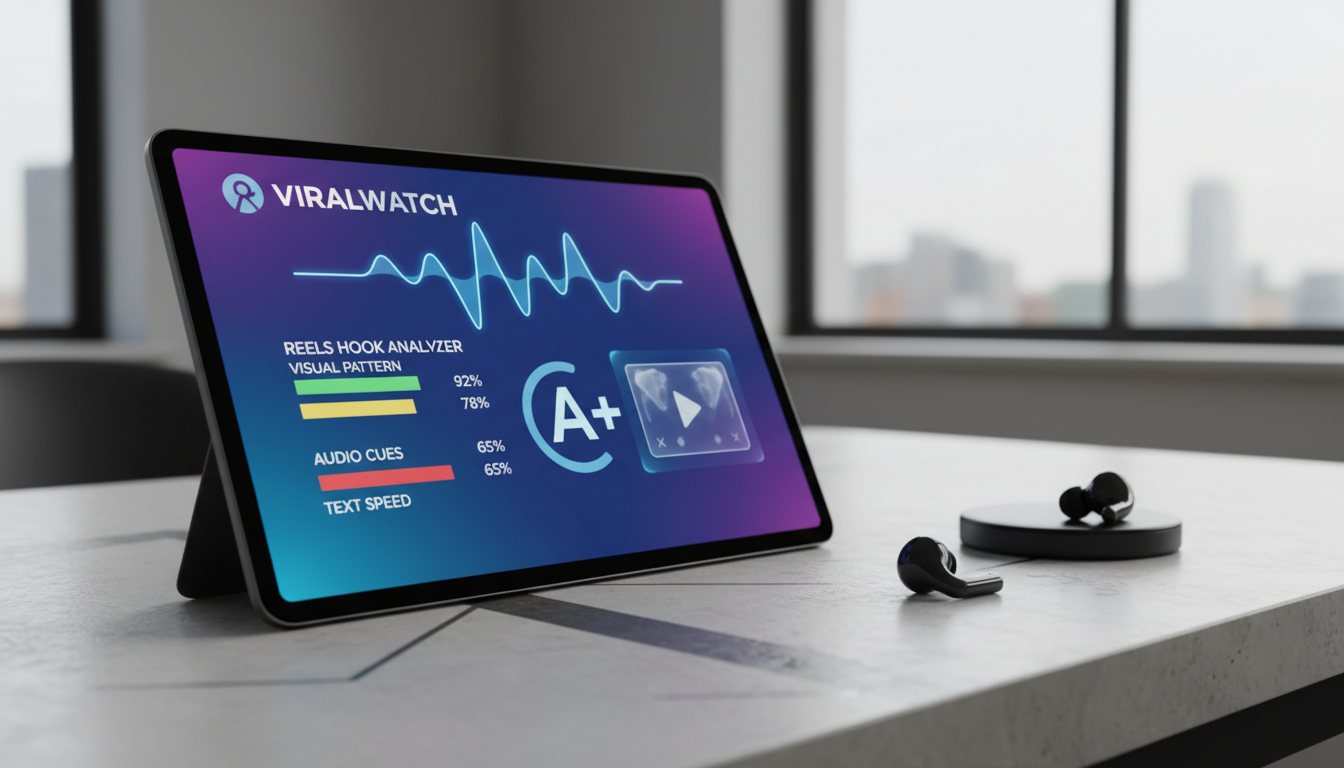
- Review Your Hook Score: You’ll receive a score from 1-100. This score predicts initial retention potential. We benchmark it against high-performing hooks in your niche. The score breakdown shows strength in each core element. This pinpoints your hook’s specific superpowers and weaknesses.
- Study the Breakdown Report: See which core elements you used successfully. Identify missing components like delayed text or quiet audio. The report includes visual timelines and waveform graphs. You see exactly when each element appears. We highlight missed opportunities in the critical first-second window.
- Apply the Edits: Use the report’s suggestions to refine your hook. Often, simple tweaks like moving text earlier or boosting audio can raise your score dramatically. Implement the changes in your editing software. Then, re-upload the new version to track your score improvement. We guide you from diagnosis to cure.
Common Hook Mistakes the Analyzer Catches
Our tool frequently identifies these critical errors that kill retention.
- Slow Start: No engaging action happens in the first full second. Viewers scroll away before your content begins. This often involves slow zooms or lengthy introductions. We flag videos where the key action starts after the 1.0-second mark.
- Silent Opening: The video starts with ambient noise or silence instead of intentional, engaging audio. Even half a second of silence can be deadly. Our audio analysis graph clearly shows a flatline where a spike should be.
- Cluttered Frame: The initial visual is too busy. The viewer’s eye doesn’t know where to look, causing confusion. Too many objects, competing colors, or dense backgrounds create visual noise. We assess frame composition for a clear focal point.
- Text Delay: Your key on-screen text appears after the two-second mark. By then, most viewers have already left. Text is a primary retention tool. Delaying it wastes your most valuable real estate. Our timeline report highlights this lag instantly.
- Missing Curiosity Gap: The hook shows everything immediately. It gives no reason for the viewer to stay and see what happens next. The hook must pose a question the body of the video answers. We evaluate whether your opening creates a compelling “need to know.”
Hook Analyzer vs. Manual Guesswork
You might try to judge your own hooks. A dedicated analyzer provides objective, consistent advantages.
| Feature | Manual Guesswork | Reels Hook Analyzer |
|---|---|---|
| Speed | Slow, relies on rewatching and feeling. | Instant analysis in under 10 seconds. |
| Objectivity | Biased by your own attachment to the content. | Data-driven, emotion-free scoring. |
| Benchmarking | Compares only to what you remember seeing. | Scores against thousands of proven hooks in our database. |
| Improvement Advice | Vague (“make it more exciting”). | Specific (“Add bold text at 0.5s asking ‘Do you do this?’”). |
| Consistency | Quality varies with your mood and fatigue. | Provides the same reliable standard for every video. |
| Fatigue Factor | Your perception dulls after editing for hours. | The machine’s analysis remains sharp 24/7. We built it for marathon creation sessions. |
| Trend Awareness | Limited to trends you’ve personally noticed. | Continuously updates with data from newly viral hooks across platforms. |
Evidence and Numbers
Data proves the importance of a scientific approach to your hook. We base our system on these measurable realities.
- 47% of a video’s value is determined in the first three seconds, according to Instagram’s own data. Source This statistic frames the hook not as an option, but as the main event.
- Reels with on-screen text in the first frame see 55% higher average watch time. Source This isn’t a subtle boost; it’s a transformative difference anchored in visual processing speed.
- Videos starting with a clear human face have 38% higher retention rates than those without. Source Our analysis confirms this biological imperative, making facial recognition a cornerstone of our scoring.
How to Write a Killer Hook Script
Use these formulas after your analyzer identifies a weak opening. We integrate these templates directly into our suggestion engine.
- The Question Hook: Start with a bold, relatable question on screen and in voiceover. “Do your plants look like this?” “Do you make this common cooking mistake?” The question must be answered with a “yes” or a “I need to know.” It creates instant personal relevance.
- The “Without This” Hook: Promise a negative outcome the viewer wants to avoid. “Don’t make your pasta without this trick.” “You’re cleaning your windows wrong without this.” It leverages the fear of missing out (FOMO) on a better result. The hook implies a secret is coming.
- The Curiosity Gap: Show an intriguing result without revealing the method. “I turned this old jar into this in 1 minute.” “My cheap grocery store flowers look like this after one day.” The gap between the ordinary start and amazing finish creates tension. The viewer stays to learn the bridge.
- The Reaction Hook: Begin with a close-up of a shocked, excited, or confused face reacting to something off-screen. The viewer must stay to see the cause. Human emotion is contagious. A strong reaction triggers the viewer’s empathy and curiosity simultaneously.
Advanced Hook Engineering Strategies
Once you master the basics, these advanced tactics can elevate your hooks further. We see these patterns in elite-performing content.
The False Promise Hook: Start with a claim that seems too good to be true. “I learned Spanish in 24 hours.” The viewer’s skepticism keeps them watching to see the “catch” or the method. The hook plays on their desire for the promise to be real. We analyze how these hooks use exaggerated body language to sell the premise.
The Sensory Hook: Engage a sense beyond sight and sound immediately. Use text to invoke touch or taste. “This fabric feels illegal.” “Wait until you taste this crunch.” It prompts the viewer to imagine the sensation, creating deeper engagement. Our system notes hooks that successfully trigger cross-sensory imagination.
The Nostalgia Bait Hook: Use a instantly recognizable visual or audio cue from a shared cultural past. A old video game startup sound, a toy from the 90s, a specific TV show frame. This triggers an emotional memory that pauses the scroll. We track the use of these nostalgic elements in trending audio libraries.
The “Watch This” Command Hook: A direct, imperative instruction. “Watch this coffee trick.” “Watch me fix this in 10 seconds.” It cuts through ambiguity. The viewer’s brain often complies with clear, simple commands before conscious thought intervenes. We measure the clarity and confidence of vocal delivery in these hooks.
Integrating Hook Analysis Into Your Workflow
A Reels Hook Analyzer is most powerful when it’s part of your routine. Here is how to bake it into your process. We designed ViralWatch to fit seamlessly into these stages.
Stage 1: Ideation & Scripting. Before you film, test your hook concept. Write your first three seconds as a script. Ask: Does it contain at least two core elements? Does it create a clear curiosity gap? Use our template library here. This prevents wasted effort on a weak foundation.
Stage 2: Post-Filming, Pre-Editing. Film multiple hook variations for the same content. Film a question version, a reaction version, a text-heavy version. Upload all rough clips to the analyzer. Let the data choose the strongest opening before you edit the full video. We support batch analysis for this exact purpose.
Stage 3: Final Edit Verification. After you complete your edit, analyze the final product. Ensure your tweaks didn’t accidentally delay a key element. Confirm your hook score meets your target threshold (we suggest above 75). This is your final quality control check before publishing.
Stage 4: Post-Publish Audit. Once your Reel is live and has analytics, revisit it in the analyzer. Correlate your hook score with your actual retention graph. Did a high score lead to high retention? Did a lower score predict a drop-off? This feedback loop trains your intuition. Our platform saves your analysis history for this review.
By systematizing hook analysis, you remove guesswork from your biggest growth lever. Your content quality becomes consistent and predictable. We provide the framework to make this discipline simple.
FAQ
Is a Reels Hook Analyzer only for Instagram? No. While we use “Reels” as the common term, the principles apply to TikTok, YouTube Shorts, and all short-form video platforms. The three-second rule is universal. Our database and benchmarks include hooks from all major short-form platforms.
Do I need professional video editing skills to use the analyzer? Not at all. Our tool is designed for all creators. The feedback is simple to understand. The edits it suggests are often quick fixes anyone can make in a basic editing app like CapCut or Instagram’s built-in editor. We focus on strategy, not complex technique.
How is this different from general analytics? Platform analytics tell you if people left. Our Reels Hook Analyzer tells you why they left in the first three seconds and exactly how to fix it for your next video. It’s predictive and prescriptive, not just retrospective.
Can I analyze my competitor’s Reels? Yes. You can paste the URL of any public Reel into our ViralWatch analyzer. See the hook score of top-performing videos and reverse-engineer their success
Continue this workflow with How can you What is good retention for Shorts? in 2026? (Shared topic: Hook Feedback. Natural next step after Discovery.) , TikTok Hook Feedback Checklist: Fix Your First 3 Seconds (Shared topic: Hook Feedback. Natural next step after Discovery.) and What are the best Best AI Tool to Create Viral Ai Videos Fast! options in 2026? (Shared topic: Hook Feedback. Same Discovery stage.) .